
For anyone passing who does not know #ELTchat – check out the website here
Wednesday 25th July 2012 – 21h00GMT

. Normal 0 21 false false false FR X-NONE X-NONE
Although our dear moderators did try to nudge us towards the specific grammar points implied in the title of this week’s ELTchat – no one would go there and this evening’s chat brought above all a plethora of books to read, with just a few online references (videos mainly) towards the end – Would that be the call of beaches and parasols before the summer break? LOL – though actually, lots were very definitely reference books rather than a straight read.
Points brought up in the discussion about grammar and teacher’s attitudes to grammar were that:
– a “feel” for grammar is important to counteract the over-generalisations of text books, and the problems encountered when a student has been given the wrong end of the stick. (“the feel is important, esp when trying to convince that sth really doesn’t follow the rules they learned” )
-NESTs do not always have the knowledge to analyse their students’ mistakes , and PD is essential “we owe it to our students”
-some chatters found grammar book boring whereas there was general agreement on the fact that ” it is true that consulting ONE grammar only is not enough”
– it is sometimes difficult to pick up on what grammar needs to be dealt with in class, due to ss “avoidance” techniques – dictagloss was suggested as one way round this
– on the other hand, filling in grammar pages is what some ss call learning (and some teachers, and some exams…)
“There is a difference (between) knowing the grammar to isolate and help students (and) teaching it to the students”, “you need to know way more (than just one step ahead) cause u need to carefully ‘curate’ what to bring to class”
Basically, when push comes to shove, “You need to know more than ‘enough’ to be able to isolate problems and focus your help for the Ss” “in order to help them clearly and not go into info overload about piece of language”
And, although “There are several grammars published for teachers these days – no need to use student grammars as a source” the two are somewhat mixed in the list following list – which is followed by the video references:
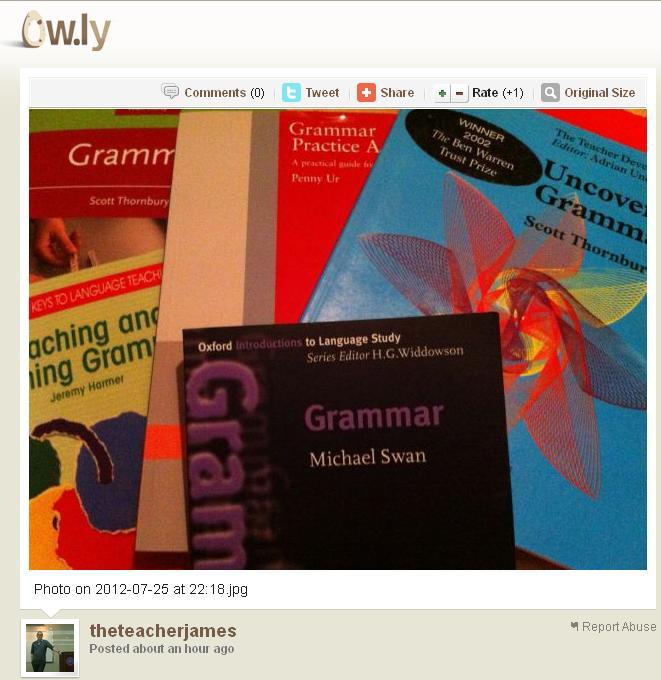
photo by @theteacherjames
Parrott’s Grammar for English Language Teachers “I regretted not having started with this BEFORE doing a CELTA”
George Yule “Explaining English Grammar” “I recommend Yule for conditionals too, gr8 approach thinking of the meaning of each clause not 1st..”
Someone mentioned Swann,
would that be Practical English Usage or The Good Grammar Book ?
In any case, there’s an interesting article (online) by Swan – “Does Grammar Teaching Work”
Normal 0 21 false false false FR X-NONE X-NONE
Murphy was not high on the list of grammar-for-teachers. But such a lovely person (online)
“The Teacher’s Grammar of English” by Ron Cowen was recommended for US English
English Grammar Today (Carter, McCarthy et al)
Teaching tenses by Rosemary Aitken was highly recommended, “especially for NNESTs” and “esp for LA assignment on a CELTA”
Grammar for Smart People by Barry Tarshis with its subtitle “your user friendly guide to writing and speaking better English” sounds like a cast off from the “Eats Shoots and Leaves” syndrome (to me, and I’m holding the pen keyboard)
When someone pointed out that the student’s L1 would influence the specific the grammar needed by teachers Marisa quickly pointed them to “Learner English” by Michael Swan, available in pdf, which highlights the specific problem zones for speakers of 22 different languages (or language families)
Normal 0 21 false false false FR X-NONE X-NONE
Meaning and the English Verb by Geoffrey Leech from U Lancaster is in it’s third edition and is still going strong after 30 years and was highly recommended though with “caution about what Leech says about degrees of certainty with the futures! #eltchat cf The English Verb – Lewis“
In a more general vein there was:
My Grammar and I (or should that be “me”?) said to be very “readable”
http://www.unfoldingoflanguage.com/ #guydeutscher
But for truely pleasureable reading , I have to slip in Jean Aitchkinson’s Reith Lectures « The Language Web » Either the book or the downloadable audio (5×45 mins)
For people wanting to take up Willy Card’s call to delve into Philiosopy, a great overview (first few chapters) in this “Fuzzy Grammar – a reader” edited by Bas Aarts (head of the Survey of English Usage group at UCL which was founded by Quirk).
_______________________
Videos – two 15 minutes of Krashen on language acquisition
Thornby, one hour video: 7 ways of looking at Grammar
Google was actually said not to be the best resource (though I find that googling the point in question preceeded by EFL ESL quizz – is extremely useful for coming up with a few questions to illustrate the discussion)
and;
“CUP are giving away a free 5 hour Grammar awareness course on their teacher network“
Normal 0 21 false false false FR X-NONE X-NONE
With thanks to all here are:
The teachers who appeared on my transcript
@Marisa_C
@naomishema
@vickyloras
@GatewaytoSkills
@Shaunwilden
@hartle
@theteacherjames
@uniquelanguages
@Wiktor_K
@idc74
@harrisonmike
@natibrandi
@BookMachine
@teacherphili
@nathanghall
@Collaborative
@CELT_Athens
@eannegrenoble
@mubeenfk
@tim_crangle
@motherchina
@DianadeBelflor
@David__Boughton
 Eannegrenoble's Weblog
Oh dear – Posterous has gone completely wobbly – when I try to get back in to edit the text, all it shows me is the first few lines and the last few lines – on top of which it did not post my comment :-(which said that I try to make online explanations of points I’m getting fed up of repeating to my (essentially) monolingual Science students http://eannegrenoble.edublogs.org/2009/02/18/grammar-against-the-rules/and a new projecthttp://eannegrenoble.edublogs.org/countable-and-uncountable-nouns/