#ELTChat summary – The importance of active listening and how to do this in an EFL classroom


The numbers of ideas thrown in during today’s chat were so numerous and varied that it’s somewhat difficult to know where to start…. So why not at the end just in case this enigmatic tweet from Brendano went unnoticed:

This leads to a video competition site where I discovered that LOTE stands for Language Other Than English and the video produced by students in that category has to be submitted with English sub-titlesJ (Note for people interested: deadline for entering  the competition – 16th Sept, although you have until 28 October 2011 to upload the video)


Early birds

Not only did the interest overflow at the end, but early birds were offered a starter with a 7 minute TED talk by Julien Treasure “5 ways to listen better” in which we learnt that we exercise filters when listening.  According to Julien Treasure, we “filter out ” the less important to reach what we really pay attention to,  in the following order:

Culture  – language  –  values  – beliefs  – attitudes  – expectations  –  intentions

In this schema, language is at the “all sound” end of the spectrum. Clearly he is not in an EFL situation ๐Ÿ˜‰  and even states with total convictionConscious listening always creates understanding”….if only !  
This TED talk has actually given rise to a discussion on the TED page itself about teaching conscious listening in school.

Julien Treasure’s key to conscious listening,  RASA: Receive Appreciate Summarise Ask   is, as sueleather pointed out, “ a useful technique to play with ….and particularly useful for teacher training (but) ..  Treasure is talking about empathetic listening in counselling sense, not about lang learning”
Basically this TED talk really underlines the added difficulties our students have deal with when listening!

 According to  @Raquel_EFL, “Research has shown that we take in 7% by words, 38% by tone of voice and 55% from body language”… interesting, though  I guess that’s in L1 again.

Also before the session started, @cybraryman, gave us a link to what looks like a very comprehensive page of links to  EFL listening sites  http://cybraryman.com/listening.html  Definitely  not to be missed.

Introduction

Wikipedia provided a definition of active listening

        “Active listening is a communication technique that requires the listener to understand, interpret, and evaluate what (s)he hears”

And resisting the temptation to go off along a different track pointed out by Carolcgoodey  Are we talking about active listening for teachers or learners?” in spite of an interesting looking link from  Barrytomalin: “The Art Of Listening And Leadership http://bit.ly/qoM16x, we focused on “how to do this in an EFL classroom” since as vickyloras summed it up: “You can take a listening task and weave it into a hundred others – that´s what I´d call active listening” … And involve the “communication” element in those tasks to make it meaningful” …” but with listening as the starting and focal point”  keeping in mind of course that  “Active listening can be helped by activating prior knowledge, previewing, scaffolding, etc.” (ghewgley Gary Hewgley)


Here is a selection of some of the comments: 


Now I’m afraid there’s an important element of this ELTChat missing – who said what – because I prepared it off-line in a silent place with no internet connection! Sorry folks. However, I have group the tweets into: 

Activities,    Taking notes,     Listen and draw,    Dictagloss,    Debates and role play,      Backchannels.


Some Activities  

A great activity which few do is getting students to repeat last words hear at first they can repeat only a very few

-Another oldie but goodie: Use pause button and get Ss to predict – who is going to talk, what they’re going to say etc

-Active listening is a two way process. I like to use think pair share to encourage active –

– using ‘think aloud’ techniques? Nice


– if we dont actually ‘hear ‘ we use repair techniques – also imp for sts … when they do it it makes the whole processes more real and worthwhile for sts

– Encourage sts to actively listen to peer responses and presentations, not just Ttalk. Ask them to paraphrase. …teach expressions like: “If I understood correctly, he means…”

-We can ask them to repeat back to speaker ‘so what you’re saying is…’ ‘do you mean…’ so they show understanding Paraphrasing can be an effective way to make sure students understand what was said.

-a task is done in pairs have the other st present to class what the other st said … Shifting stress exercises. Sts have a diff role each & 1 pretends mishearing & other other has to repeat till they achieve comminucation

– Modeling is so important. We often assume students know/understand how to do something

-i did a lot of work in my on specific questions for clarification e.g. you went where? you did what? it was really useful

For games, Hot Seat is fun. Person in the chair has to listen and filter noise from other team.


taking notes or put-your-pen-down?

-DNA=DoNotAssume your students have notetaking skills

-we don’t do that much listening in life with p&p in hand ๐Ÿ™‚ but on the phone yes !

-But pen and paper in hand not only way of listening actively – smtms good to use phy
sical tasks esp for younger learners

-Activity increases brain productivity.

– standing up reminds me of Ken Wilson’s workshop

– i like the idea of physical tasks. clapping, standing up, raising hands… is this the adult equivalent of this making polite noises?

Listen and draw

– Some people more inclined to draw than note take. Challenge them 2make infographics

Dictogloss – Grammar Dictation

-Dictogloss is a good training of ears and short term memory

-here’s a version of Rincolucri/Morgan’s unicorn dictation tht I did with a celta course (techologically) http://bit.ly/no9v1u

-‘Grammar Dictation’ -discuss topic,read out short passage,sts take notes then reconstruct in groups

-a great book w/ passages for diff levels   … here it is http://bit.ly/oggDPc by wajnryb a book on dictogloss a

Debates and role play:

-Debates are great way to get students to actively listen – the ‘ceremony’ dictates the need

Here’s the format I use for Lincoln-Douglas debates http://bit.ly/pw54sQ

If you’re looking for debate materials, ESL-Library has a section: esl-library.com/debates


-Other great active listening tasks can include mock trials, mock UN, informal debates.

– mock trial is when 1 student put on trial w/ lawyers, notetaker, etc., rest of class the jury, reporters! All have a role

– You can use a fairytale or story in your mock trial:. 3 pigs vs Wolf. Jack and the Beanstalk (Jack for murder),

– I love stories too like the Once Upon a Time activities (Rinvolucri)

-plays & classics can be given a modern twist, as well. Debate Romeo & Juliet in the style of Jerry Springer ๐Ÿ™‚


-A mock United Nations is basically a group of students from each institute representing a diff country for policy agreemt

-Listening/participating as part of a group and then going to another group to share what you learned
-VERY complicated researched roles http://1.usa.gov/mUtcp1 … you can find simulations like these in all fields – e.g. business management training

Backchannels

Has anyone played with using a backchannel to promote active listening in class? I know it helps me to tweet, etc at conferences

-with freshmen & grad students. Works great to have twitter feed scrolling on the screen.

The essential tool for backchanneling in class http://todaysmeet.com/
And finally a discussion about active backchannelling i.e. encouragning the students to speak to each other while listening apart from the thought:
-Have you tried it? > Not intentionally, but those teens do it anyway, maybe shouldn’t shush them
-I think maybe small doses of listening mixed with chatting then listening then chatting

-Depends who says what to who about what I guess..difficult to check while listening (or ever?)

@mcneilmahon speaking during a listening? revolutionary! gonna try it tomorrow ๐Ÿ™‚

But then, as several people said during the discussion “there’s a lot of blog posts waiting to be written here” !

I look forward to reading you ๐Ÿ™‚

My name is Elizabeth Anne ( eannegrenoble ) and I am clinging on to my status of digital visitor rather than resident (have you seen the video ?), although I have been webmaster of our departmental web site for quite a while.

New to ELTchat?

If you have never participated in an #ELTchat discussion, these take place twice a day every Wednesday on Twitter at 12pm GMT and 9pm GMT.  Over 400 educators participate in this discussion by just adding #edchat to their tweets. For tips on participating in the discussion, please check out this video, Using Tweetdeck for Hashtag Discussions!

PLNs and thinking in words

Wow, I’m thinking in words !

And I’ve just realized that when people ask “what language do you think in ?” they mean this kind of thinking.

But this kind of thinking is daydreaming


“thinking-in-words” doesn’t make sense otherwise for 2 reasons:
a). doesn’t everyone “feel” how much faster thoughts are than words ? (and what about the technicolour
 )
b). How would ANYONE ever have to say “I can’t find the words” – in their L1 that is – if the thought were in words to start with


And why was I thinking in words today?

Well………. Because I was driving along daydreaming that I too could write a blog ๐Ÿ™‚  

In fact I was thinking I too should write a blog

SHOULD write a blog ??

After watching Marissa’s aPLaNet Prezi and thinking of how I have benefitted from my PLN, it already seemed as if I am taking rather than sharing but now that SueAnnan’s interviewed me, it seems I really do have to move on from my work only use of the internet….

especially, and above all, because like many, I’m enjoying Brad’s PLN interview challenge and boy would I like to interview Marissa ๐Ÿ™‚ So I am creating a space in which to post the interview…. fingers crossed.


#ELTchat NNESTs and pronunciation – an article by Krashen

I asked for permission to put a link to this doc, sent as a pdf file, onto the dept web site. I received a very enthousiastic reply saying that everything he writes is totally available to be reproduced anywhere, so here are the contents of that .pdf file:

A Conjecture on Accent in a Second Language
Stephen Krashen
In: Z. Lengyel, J. Navracsics, and O. Simon (Eds.) 1997. Applied Linguistic Studies in
Central Europe, vol 1. Department of Applied Linguistics, University of Veszprem,
Hungary.
Scientists use the term “conjecture” when their generalization is based on such flimsy evidence that it does not deserve the label “hypothesis.” This is such a case. My conjecture is that accurate pronunciation in a second language, even in adults, is acquired rapidly and very well. We simply do not use our best accents because we feel silly. Restated in more respectable terms, we have an “output filter,” a block that keeps us from doing our best, from “performing our competence.” This block is powerful and it is difficulty, maybe impossible, to lower or weaken it with conscious effort. (The output filter differs from the affective, or input filter. The affective filter prevents input from reaching the language acquisition device. The output filter prevents us from using what we have acquired.)
Here is the flimsy evidence. Much of it is based on my own experience, but I suspect, after presenting these ideas to a number of audiences and getting reactions, that others have had similar experiences.
1. Variability: Our accents in second languages vary, depending on how we feel. We are influenced by the situation, especially whether we feel we are being evaluated. When I speak French to someone who doesnโ€™t speak English (or at least not very well), where there is no audience, and I am comfortable with that person, I must say that my accent is not bad. On other occasions I have been told that I speak French without a traced of a French accent.
Here is an example of the latter, an experience I hope some readers can identify with. I was visiting Ottawa in the early 1980โ€™s, meeting with former colleagues, discussing, in French, our work on sheltered subject matter teaching which had begun when I worked there a few years before. I was very comfortable with the group I was talking with; they included a close friend and my former French teacher. I was doing very well. While I was at the chalkboard, making a point, a stranger entered the room. My mind raced: This man is probably a native speaker of French, or at least much better than I am, and he probably thinks my French is terrible. My accent and fluency deteriorated immediately and
involuntarily. In other words, my output filter went up. One of the most accomplished polyglots in the world, Dr. Kato Lomb of Hungary, reports that she has had similar experiences. Now 88, Dr. Lomb has acquired 17 languages and is now working on Hebrew. I visited Dr. Lomb several times recently, and we spoke English (her English is excellent). On one visit, my wife and daughter came with me. Dr. Lomb remarked to me that she felt her accent in English had been better when we were alone. She explained that she felt quite comfortable with my wife and daughter, but the fact that she did not know them as well as she knew me caused a small amount of selfconsciousness and hurt her performance. Dr. Lomb is an enormously successful language acquirer and an experienced interpreter; if she feels the effects of the output filter, we can be sure others do.
2. Our ability to imitate other dialects of our first language, as well as foreign accents.
Given sufficient input, we can all do these things to at least some extent. The point is that we do not, because we would feel uncomfortable doing so. The output filter holds us back.
I can imitate, to some extent, a British accent. I have acquired the rules for doing so subconsciously, and have no idea what kind of articulatory adjustments I am making when I do it. I do not, however, use a British accent when speaking to someone from London. My perception is that it would be rude, and even ridiculing, as if I were making fun of his speech, or as if I were representing myself as someone I am not. Similarly, we can imitate foreign accents in our first language. Obviously, we do not do this in ordinary conversation. It would, we feel, be perceived as rude.
There are domains in which the use of these accents is permitted, in plays and jokes, for example. Even in these situations, however, their use is sensitive. In plays, dialects must be rendered very accurately, and in jokes their use can be demeaning.
Our ability, yet reluctance to use accents and dialects again shows that we do not perform our competence fully and that there are powerful affective forces holding us back.
3. The alcohol study. Guiora, Beit-Hallahmi, Brannon, Dull, and Scovel (1972) asked subjects to drink different amounts of alcohol after eating a candy bar. Not unexpectedly, they reported that subjectsโ€™ short-term memory decreased with greater consumption. Accent in a foreign language, however, was best after subjects drank 1.5 ounces of bourbon. It was less accurate with both less and more than this amount of alcohol. There was, in other words, an optimal point of inebriation. As most of us know, alcohol has the effect of lowering inhibitions. My interpretation of these results is that alcohol lowers the output filter, at least temporarily. Too much alcohol, however, disturbs control of the speech apparatus.
4. Stevickโ€™s example. Stevick (1980) describes a Swahili class he taught at the Foreign Service Institute that had three students in it. One was at a significantly higher level than the others. When the top student had to drop the class, the number two student suddenly
showed a dramatic improvement. My conjecture is that his output filter lowered, freed from the inhibiting influence of the better student.
Discussion

To understand what factors are at work here, we need to consider what language is for. Sociolinguists tell us that language has two functions: To communicate and to mark the speaker as a member of a social group. A part of language that plays a major role in marking us as members of a social group is accent. Accent has little to do with communication; we can communicate quite well in another language having acquired
only some of the sound system. Accent tells the hearer who you are, where you are from, in some cases your social class, and in other cases your values. When we identify with the members of a group, we talk the way they do.
Beebeโ€™s review (Beebe, 1985) confirms this. We do not always imitate the speech we hear the most. Children usually talk the way their peers talk, not the way their parents or teachers talk. (In some cases, children do talk like their parents; these children identify
with adult values, rather than those of other children, confirming that it is group membership that counts.)
My conjecture is that accent is acquired rapidly but is not performed, because we do not feel like members of the group that uses it; we are not members of the club (Smith, 1988). Either we do not wish to be members or have not been invited to be members. And even after we feel we are at least partly in the group, we can feel suddenly excluded, resulting in a stronger output filter.
If this conjecture is correct, it has interesting implications for pedagogy. Despite the numerous “accent improvement” courses available, there is no evidence that second language accent can be permanently improved by direct instruction. Even if we could improve accent through instruction, however, the effect might be harmful. Getting people
to talk like members of groups they do not belong to may be similar to convincing someone to wear inappropriate clothing – a tuxedo at an informal lunch or a jogging suit at a formal dinner.
This conjecture does not suggest that all those with accents in their second language who live in the country where the langu
age is spoken have failed to become members of society. In fact, it suggests the contrary. Most second language acquirers have good
accents. Listen to them carefully. They are rarely perfect if they began the second language as adults, but they typically acquire an impressive amount of the sound system.
They certainly do not speak the second language using only the sound system of their first language. The problem is that we usually make “all or nothing” judgments with respect to accent. Either it is native-like or “accented.” In reality, many second language acquirers acquire substantial amounts of the second language accent. In addition, it is likely that we hear them under less than optimal affective conditions: with lower output filters, they may sound even better.
If this conjecture is correct, another conclusion we can draw is that only our “best” accents, produced under optimal conditions, should be considered when judging accent quality or when discussing the limits of adult acquisition of pronunciation.
References
Beebe, L. 1985. Input: Choosing the right stuff. In Gass, S. and Madden. C. (Eds.) Input
in Second Language Acquisition. New York: Newbury House. pp. 404-414.
Guiora, A., Beit-Hallahmi, B., Brannon, R., Dull, C. and Scovel, T. 1972. The effects of
experimentally induced changes in ego status on pronunciation ability in a second
language. Comprehensive Psychiatry 13: 421-428.
Smith, F. 1988. Joining the Literacy Club. Portsmouth, NH: Heinemann.
Stevick, E. 1980. Teaching Languages: A Way and Ways. New York: Newbury House

#TESOLFR

Well well well – Now that Selly Terrell‘s said it all in THREE fabulous blog posts, and Eva‘s given her great personal overview and somewhere on Mike‘s prolific and interesting blog is the first-off-the -starting-blocks account of the weekend, Karen‘s had her brilliant shout out, and  Anita has already said how she didn’t feel lonely for a second and, and, and – what more can I say?

Just that the start out of this Posterous, “becoming an e-citizen”,  has taken on a whole new dimension. It was really hard “speaking” into the ether, but now that Sue Lyons has got not only a face but also a fab singing voice and a (shame, shame) newly discovered really useful website (and a great story – guest blogger N° 19 !) , Sue Annan – a teacher right through to the tip of her fngers (as we say in France)  ALWAYS finds just the right thing to say ๐Ÿ˜‰ and Vicki Loras is sooo sweet, I can finally believe that everyone else is really real too Good grief how come I didn’t mention the fabulous and generous Marissa – who’s talk I missed ๐Ÿ˜ฆ

And though, as usual, pressing here-and-now concerns stop me from going further to reach the aim of this post which was to speak about the incredible back-up from “my PLN” at the TESOL France November weekend – the first time I’d actually spoken at an international event –  I’ll leave this here since is is another milestone (one every six months ?) on my personal journey to becoming an e-citizen !

and maybe my wordpress blog might actually grow too !

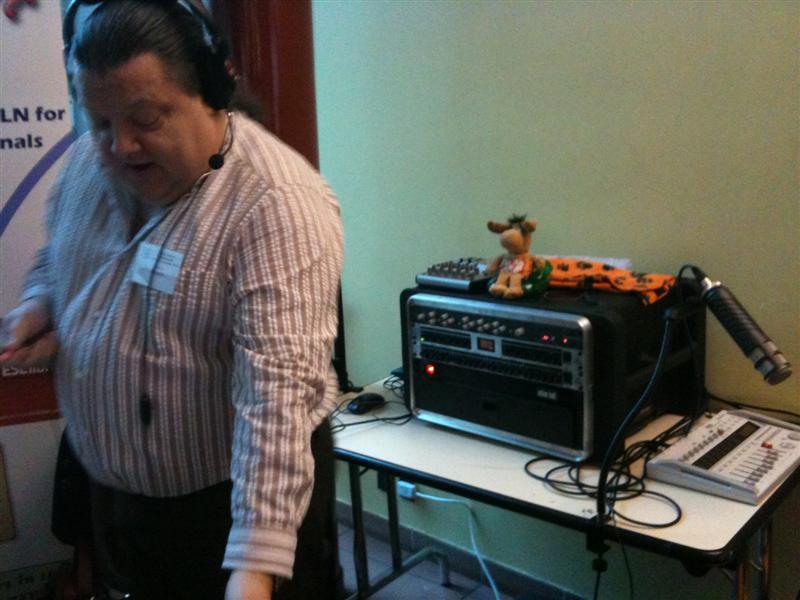
Hey – some photos – see the size of the equipement Andy brought by train ! ELTchat

Img_0432_mediumImg_0422_mediumImg_0429_medium


Becoming an e-citizen (2)

One of the angels mentionned below  has really come of age on the internet with a beautiful blog http://collablogatorium.blogspot.com/  with this really useful slideshare http://bit.ly/ccarlaa embedded in it. Sharing all her findings all the time.

When starting out with internet tools, the very first think is to write down all of the sites you use with the login and password. Never ever ever think you will remember that one. The day you want to show someone – and it’s not the password you thought it was – is sooooo frustrating.

When I first joined EVO, in 2007, it took me more than 3 weeks to really believe the people I was writing to and even speaking to on WizIQ, elluminate and _______?_____ were really  real people. I mean it is a bit odd (for a French person at least) to “speak” to people you don’t know. With a sort of undercurrent of the-aim-is-to-become-well-know-and-make-a-maximum-of-contacts.

But, hang on a minute… maybe, apart from Adam Love of Twibes, that undercurrent was purely a personal construct.

Anyway, I was able to start with my class when I realised that nobody cares what I,  Elizabeth Anne, puts on the internet ๐Ÿ˜‰

The story to encourage my students to dare to write on their blog or wiki goes as follows:

You never say “I’m not going into town incase I meet someone I know” – and you know that, when you do go into town, very occasionally you do bump into someone… well the same goes for the internet. No one, except a very limited number of people who know you already, are actually going to be interested enough to read what you “say”.

So there we have it… 3 years later, I am trying to practise what I preach ๐Ÿ™‚


Becoming an e-citizen

What a great title – not mine of course, but seen used by Karenne Sylvester. I don’t blog because I’m no good at findng the words – when it’s in writing

362

I wanted to reply to Jennifer Verschoor ‘s question “why do we blog” to explain why I don’t blog and I actually did write a personal email – but it came back to me – wrong address

323

I met the angels of ELT on the internet, aka the webheads who run EVO, some 4 years ago. Being reasonably computer literate I am supposed not to have a problem with the technical side, (although the even the technical goal posts have moved) but becoming an e-citizen, now that’s something else.
I will blog ! I will blog ! I will